Tender procedures in AEC projects can be heavy: piles of documents, strict rules, and big stakes for everyone involved. For commissioning clients, one of the key challenges is communicating project requirements clearly. What needs to be achieved? What are the technical and functional requirements? What are the risks? And where does the scope begin and end?
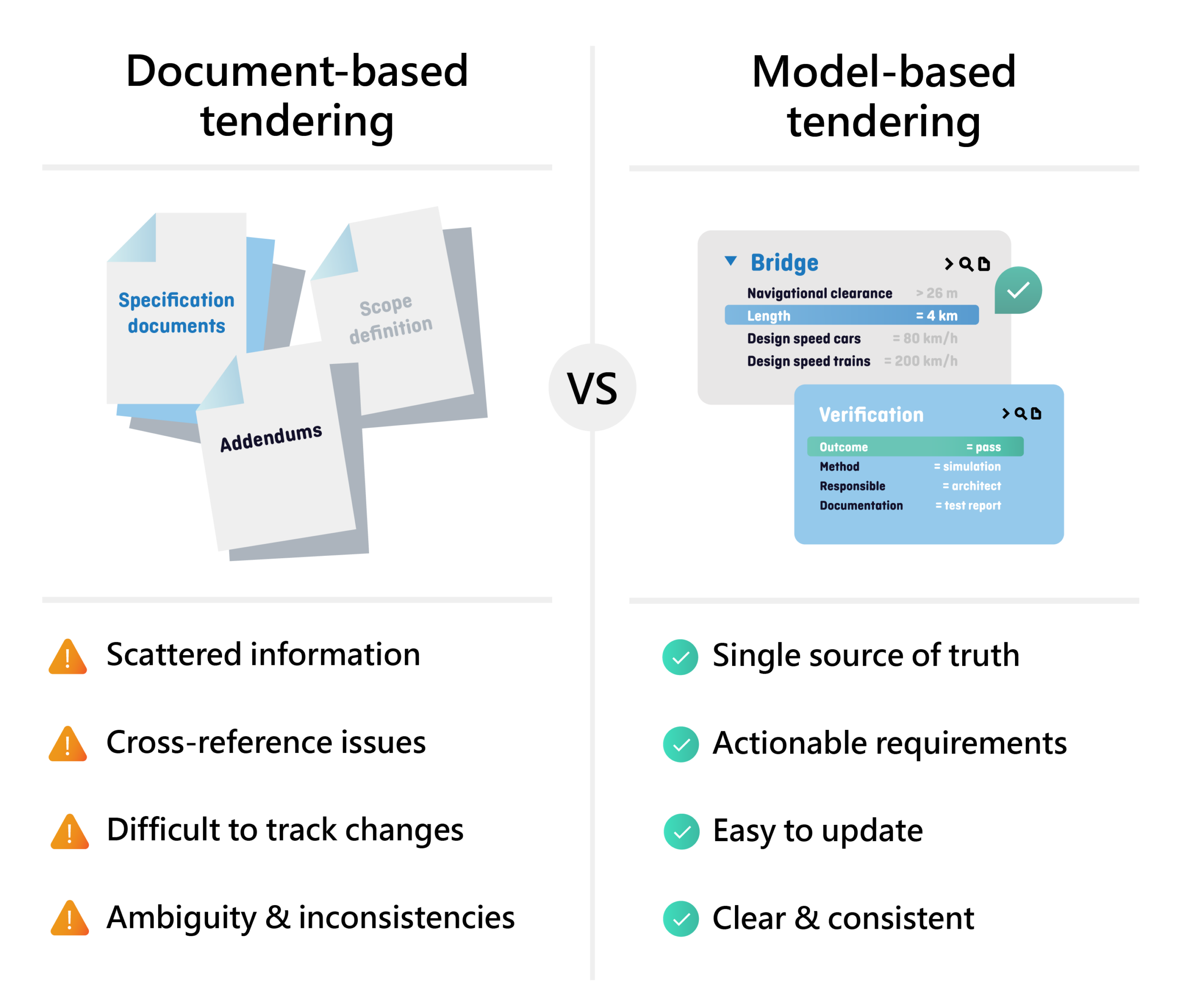
Traditionally, the answers to these questions are captured in specification documents — many of them. For projects such as tunnels or hospitals, it is not unusual for tender packages to run into hundreds of pages, with requirements repeated across different documents or, even worse, expressed slightly differently in each location. This makes it harder for tenderers to understand what is truly expected, and therefore harder to develop strong, well-aligned bids.
For that reason, more and more construction clients are adopting a different approach: capturing requirements not in documents, but in a structured model.
That may sound complex. In practice, it is surprisingly straightforward.
When modelling requirements, you are not writing long narrative text. Instead, you create a structured, clickable breakdown of the project, not unlike a file structure in a standard explorer. Each part of the project — spaces, systems, subsystems, elements, processes — becomes an object in the model. And for each object, you add requirements in a consistent format: a clear description, a value or performance level, a unit of measure where relevant, and a unique ID. All of this easily accessible through a web browser, acting as a ‘single source of truth’ for the tender.
Adopting this way of working may require a shift in mindset and some upfront effort — but the benefits are substantial.
Stronger proposals
Clear requirements lead to better proposals, simply because tenderers get a better understanding of what they have to deliver. When requirements are explicit, rather than buried in poorly structured text, tenderers can focus on quality and optimisation instead of guessing what the client intended.
Less fragmentation
Requirements are no longer scattered across specifications and appendices but captured in one structured model. For tenderers, this makes it much easier to explore what applies where. Selecting a specific space or system immediately reveals all applicable requirements in one place.
Clear identification
In an application such as BriefBuilder, each object and each requirement automatically receives its own unique ID. These IDs can be used in communication between the commissioning client and tenderers, so questions, comments, and proposed changes can always refer to a specific requirement. The same IDs can also be used to the exchange of data with other applications.
Facilitation of BIM workflows
For design and engineering teams, traditional tender documentation — think large PDF packages — is difficult to use directly in BIM models. Information must first be interpreted and then manually transferred. With a tool like BriefBuilder, this is different. Requirements can easily be imported into BIM tools such as Revit, providing an immediate starting point for design development.
Systematic compliance checking
For tenderers, a requirements model makes compliance checking far more efficient. Instead of building compliance matrices manually in spreadsheets, they can generate tabular overviews of requirements in just a few clicks and add fields (e.g. compliance outcome, references to proposal sections, and responsibilities). This improves both efficiency and accuracy in bid preparation.
Change management
In longer or dialogue-based tender processes, it is common to refine requirements in response to questions from tenderers. With a model-based approach, this can be done systematically by publishing versions. Changes can be documented and communicated transparently, ensuring that all tenderers work from the same clearly defined basis.
Continuity beyond the tender
When requirements are managed in a model during tendering, that same model can continue into design, BIM coordination, verification, and delivery. There is no handover gap between procurement and execution. Decisions remain traceable, and the original intent stays visible throughout the project lifecycle.
Conclusion
There is a great deal to gain from a model-based approach to requirements. It improves clarity, reduces fragmentation, enables precise referencing, and makes compliance checking and change management significantly easier.
The only benefit of the traditional, document-based way of working is that it is familiar. It is what people are used to, and it feels easy: anyone can start writing requirements in a Word document—right? But that approach often creates exactly what clients want to avoid — confusion, avoidable questions, and bids based on interpretation rather than intent.
In our view, it is time for change. A model-based approach helps to define requirements that are clear and actionable. And that leads to more realistic and better aligned bids, which is beneficial for both clients and tenderers.
Triggered by what you read?
Request a free trial or contact our team for a short demo of how BriefBuilder can help streamline and improve your tender.
Already working in BriefBuilder?
Read our step-by-step support article on how to prepare and use your model in a tender procedure.